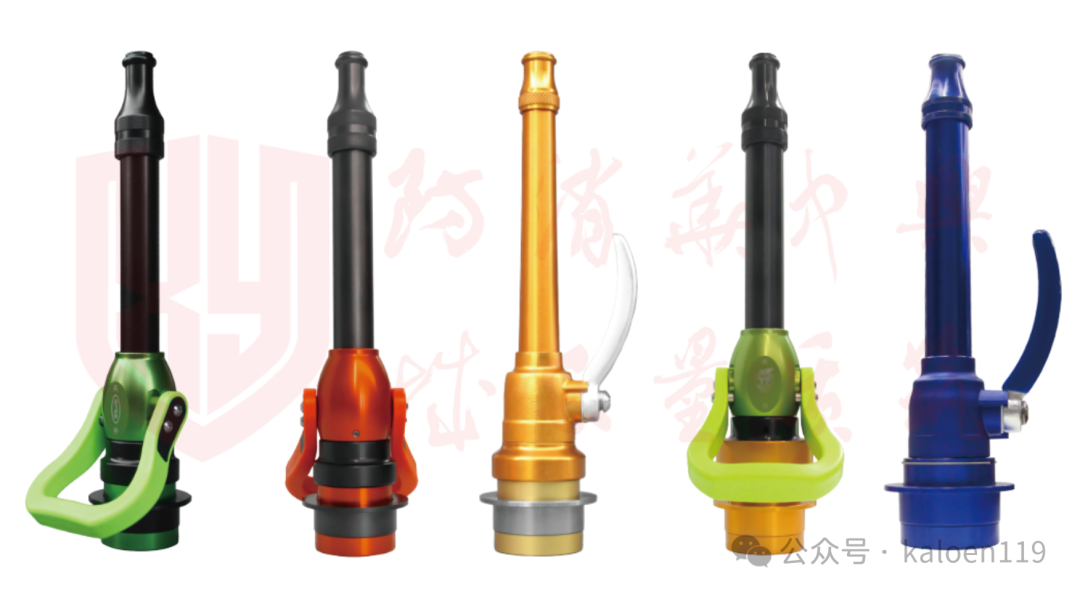
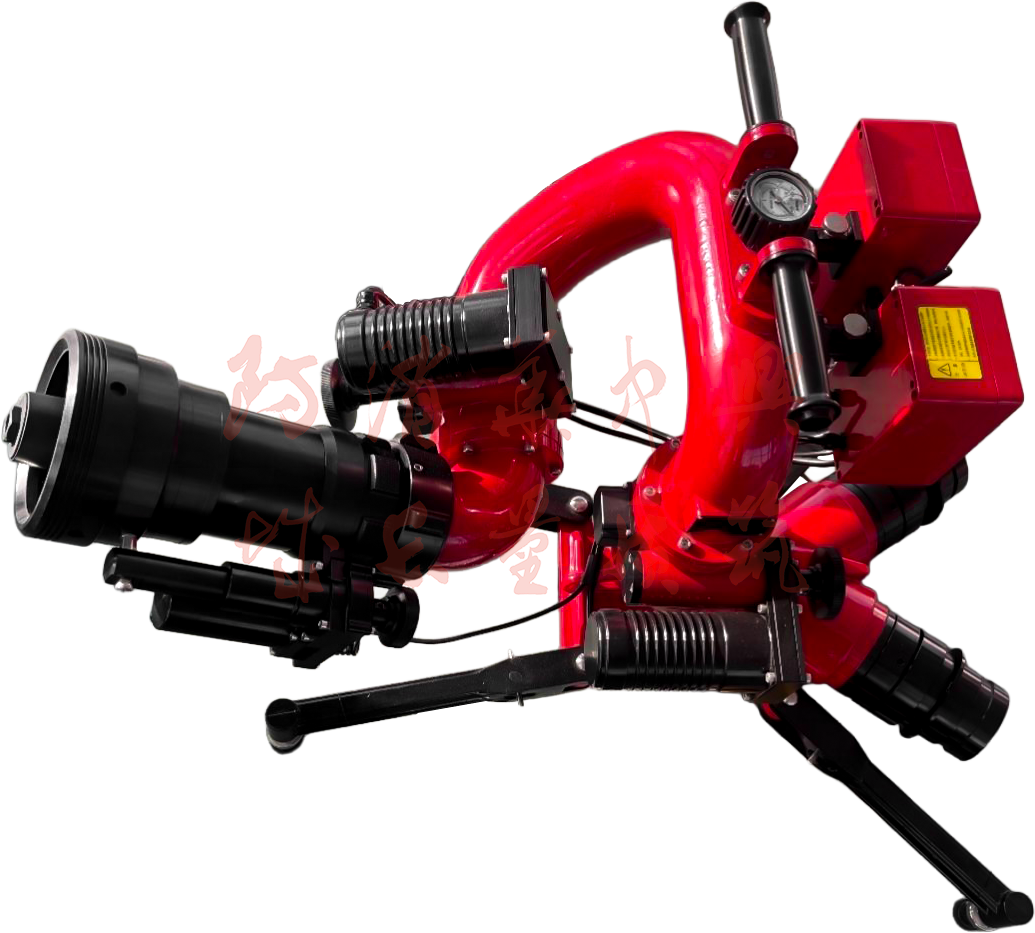
A portable mobile fire monitor delivering 30 to 80 L/s at 0.8 MPa, jet reach up to 85 m, water-mist curtain for tank cooling and steam dilution. Manual or DC24V remote control. More configurations from XIAOYUN.
A water monitor that two people carry into places a fire truck cannot reach. 30 to 80 litres per second at 0.8 MPa, a jet that lands up to 85 metres out, and a nozzle setting that turns the same water into a protective mist curtain.
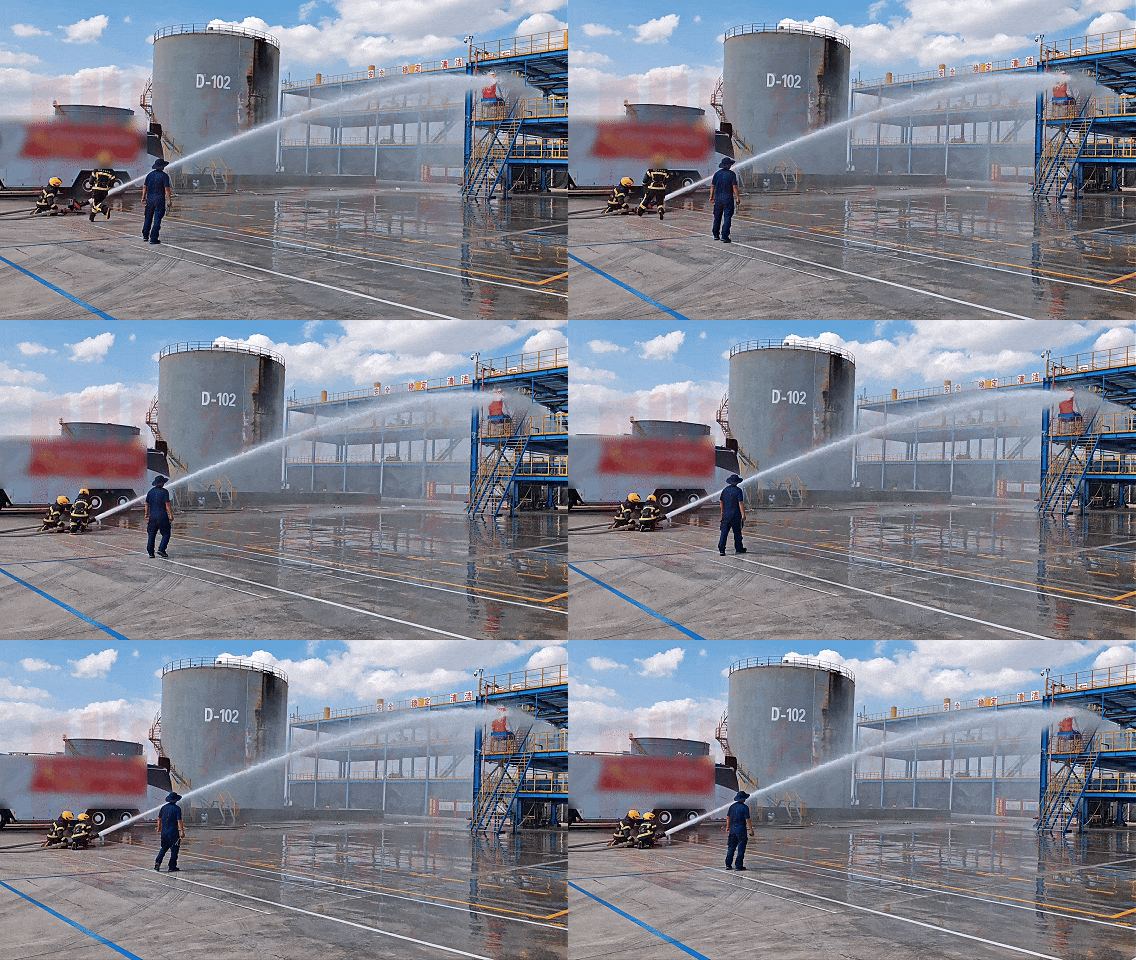
A mobile fire monitor is a portable water monitor that is carried to the fire, set on its own stabilising legs and fed by hose. A fixed monitor cannot move once it is anchored. A fire truck is limited by the vehicle: its width, its turning circle, the hose it carries. The portable monitor decouples water delivery from the appliance. Xiaoyun builds five configurations between 30 and 80 litres per second, with manual control or a DC24V electric remote, spray and self-oscillation options.
The gap in coverage
Where the appliance stops, the monitor starts
Most large fires are fought from the edge of what an aerial or a handline can reach. The difficult ones start inside that edge.
Old districts, narrow lanes
Two-metre gates, parked cars and overhead wiring. A pumper cannot bring its monitor within useful range of the seat of the fire.
Chemical tank farms and loading gantries
A fixed monitor covers a fixed cone. When the fire moves between bunds, or a flange fails two bays down, the cone does not follow.
Plants, warehouses, docks
Fire runs across a wide footprint faster than a handline can be repositioned along it.
Underground retail and car parks
Heat and smoke stop crews short of the seat. A monitor set at the ramp mouth keeps water on it from outside.
Forest edge, petrol station, residential block
The fire front is beyond the reach of an appliance-mounted monitor, and there is no structure to mount a fixed one.
What these five cases share is a distance problem: the water has to arrive from a place the appliance cannot stand.
Deployment
Four moves from the tailgate to water on the fire
There is no pump to start and no outrigger to level. The unit is placed, connected and aimed, and nobody has to hold it while the fire is being fought.
Carry it in
Two people carry the monitor by its frame to a spot within hose reach, clear of the collapse zone and outside the radiant heat that would soften the hose.
Spread the legs
The stabilising legs go out and the ground is checked. Reaction force at 80 litres per second is not something a soft verge will hold.
Connect the supply
Hose to the inlet, and a supply that can hold 0.8 MPa at the flow of the model chosen. The monitor delivers water; the pumper, hydrant or pump set provides it.
Aim and hold
Handwheels on the manual models, or the DC24V remote with a control radius rated at 150 metres. Elevation runs from +30 to +70 degrees, horizontal sweep covers 90 degrees, and the oscillating models keep sweeping on their own.
Performance
Long throw buys distance. Flow buys the knockdown.
A single monitor at 60 litres per second puts more water on a seat of fire in one minute than a crew can move by handline, and it does it from a position nobody has to hold.
- Reach against the fire front. Jet range in this family starts at 60 metres at 30 litres per second and reaches 85 metres at the top of the range, so the unit can stand off beyond radiant heat.
- Knockdown, then cooling. The stream that darkens a fire down also keeps water on a tank shell, a vessel or a loaded trailer, holding steel below the temperature where it starts to lose strength.
- Wide coverage spray. The spray setting spreads a full cone over a warehouse floor or a yard, which is what stops fire walking sideways through stacked goods.
- No operator in the heat. The unit is aimed from behind the appliance, from behind a wall, or from the remote.
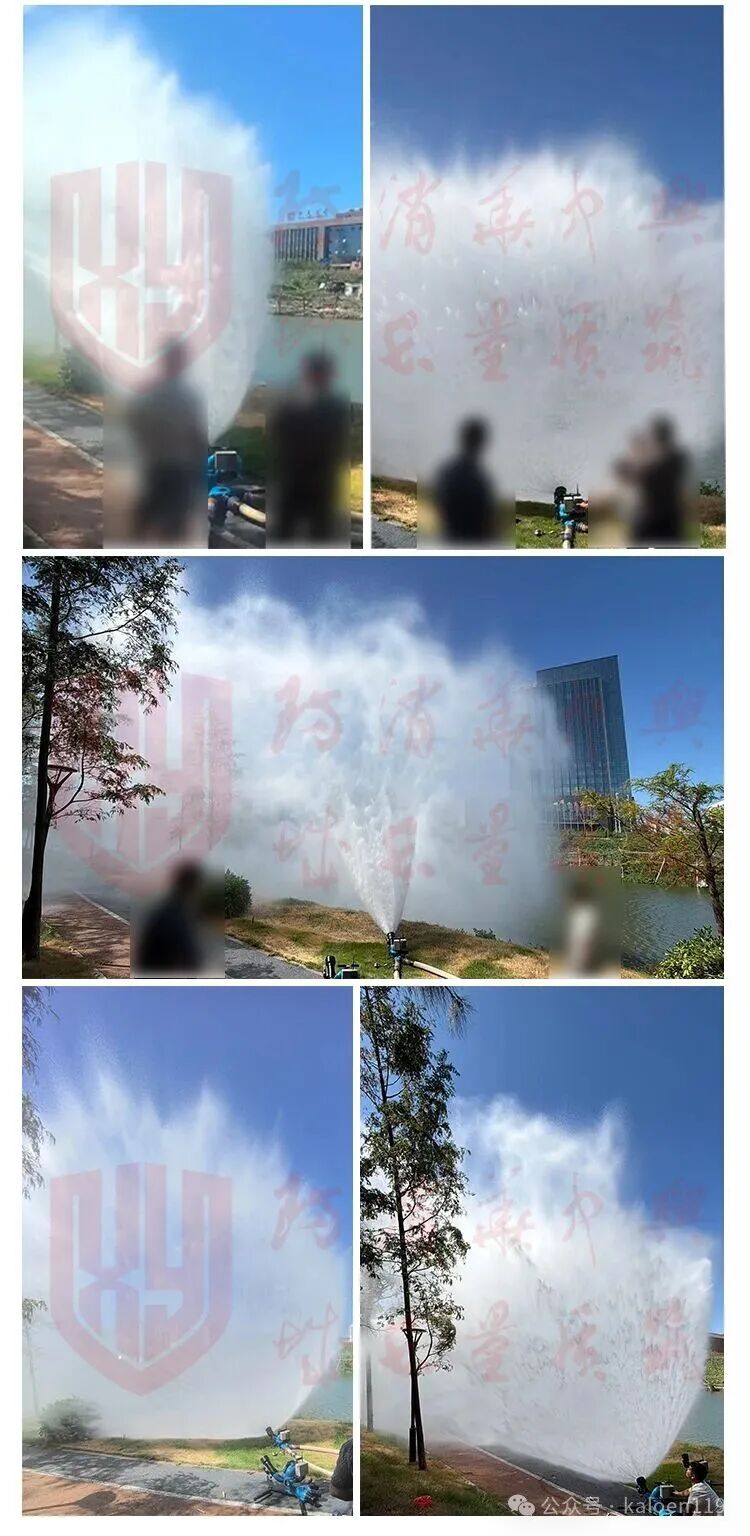
The deflector sits at the nozzle outlet. It converts the column into a fan of droplets, a deliberate trade of reach for protected area.
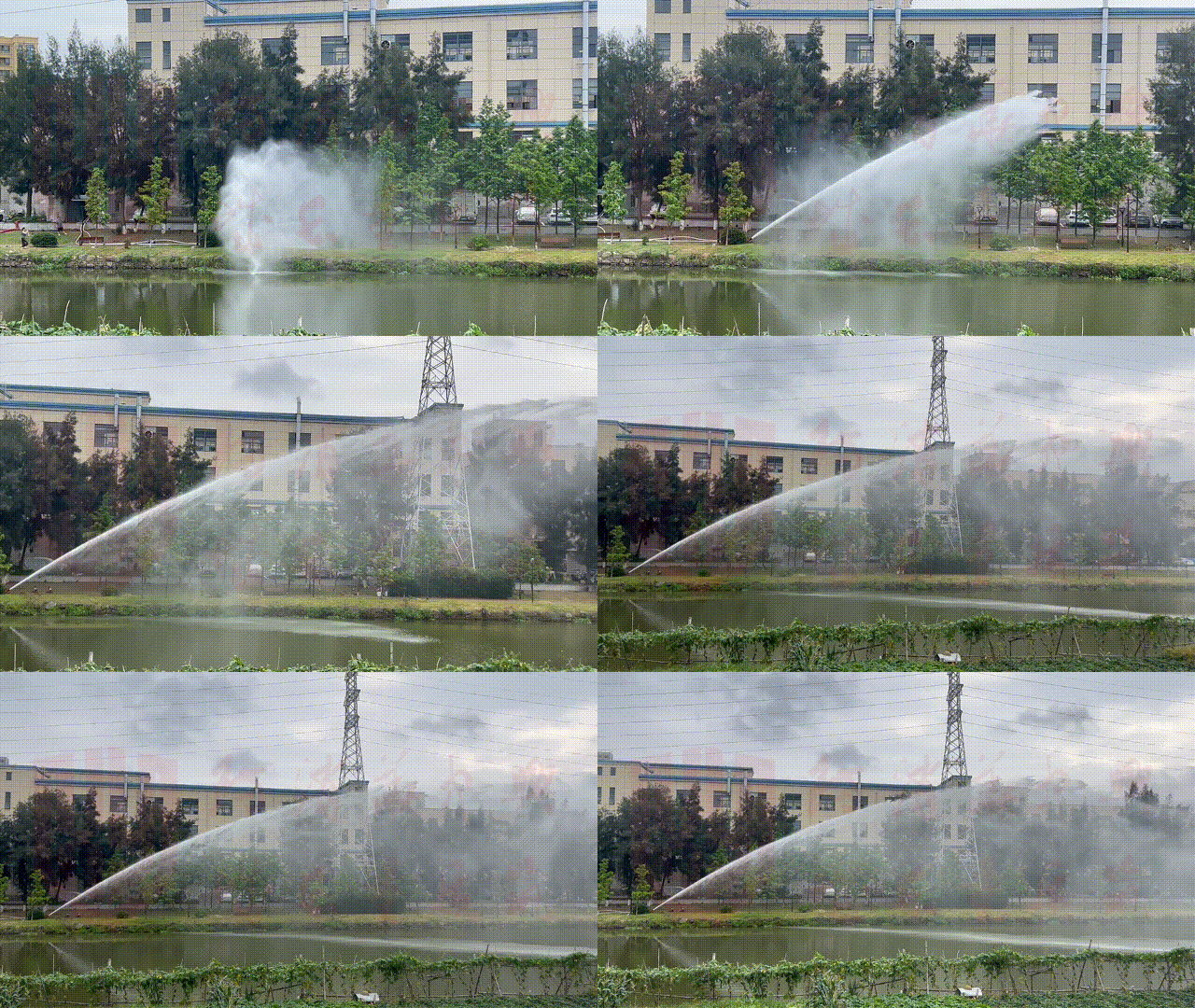
Water mist
One monitor can hold a curtain, not just a stream
The deflector at the nozzle outlet changes the direction of the water. A high-pressure column is broken into a fan and cone of fine droplets, and the difference is more than cosmetic.
Divide the same volume of water into droplets and the surface available to absorb heat rises sharply. Against a tank shell, a loading arm or a bund wall, that means faster cooling per litre delivered. Where the water meets the fire it turns to steam, and the steam displaces oxygen and dilutes the flammable vapour at the boundary, which is why a monitor set to spray does three jobs at once: knockdown, cooling and dilution.
The cost is range. A mist setting throws shorter than a solid stream. What grows is the footprint being protected. Set a self-oscillating model to sweep and one unit holds a continuous moving curtain across a front, without an operator standing in the open to keep re-aiming it.
How to choose. If the task is to break the back of a fire, run the solid stream and place the unit far enough out. If the task is to protect an exposure, cool a tank or hold a vapour cloud at the bund, run the fan and accept the shorter throw.
The range
Five configurations, one supply pressure
| Model | Control | Spray | Self-oscillation | Nominal flow | Jet range, water |
|---|---|---|---|---|---|
| PSKDY8/60W | Electric remote | Yes | No | 60 L/s | ≥ 75 m |
| PSKDY8/80W | Electric remote | Yes | No | 80 L/s | ≥ 85 m |
| PSY8/40WB | Manual | Yes | Yes | 40 L/s | ≥ 65 m |
| PSY8/30W | Manual | Yes | No | 30 L/s | ≥ 60 m |
| PSY8/30WB | Manual | Yes | Yes | 30 L/s | ≥ 60 m |
Jet range against nominal flow
Read the designation: PS is a water monitor, KD an electric control, Y the portable mounting, 8 a rated pressure of 0.8 MPa, the figure after the slash the nominal flow in litres per second, W the spray function and B self-oscillation.
Common to the family: working pressure 0.8 to 1.2 MPa, maximum spray angle 120 degrees or more, elevation +30 to +70 degrees, horizontal sweep 90 degrees, DC24V for the remote models, wireless control radius rated at 150 metres. Inlet connection is supplied to the customer specification. Jet range is stated for the monitor class and is confirmed on the test sheet issued with each order, because reach at the site depends on inlet pressure, nozzle setting and wind.
More Details:firefighting & smoke exhaust range
Questions we are asked
Before you specify
Short answers to what procurement teams and station officers ask first.
Can one person deploy it?
Two people carry it comfortably, and a single person can move and operate a light body once it is positioned. Setting the legs and connecting the hose is quicker with a second pair of hands, and the electric remote models let the operator step back once water is on.
Does it need a fire truck to work?
It needs a pressurised supply, not a truck specifically. A pumper, a hydrant main or a pump set that holds 0.8 MPa at the flow of the chosen model is enough. The monitor itself has no pump.
What supply size does the range need?
Between 30 and 80 litres per second depending on the model, at 0.8 MPa at the inlet. A hydrant that feeds a handline will not hold an 80 litre per second unit, so check the supply before choosing the flow class.
Can it be used with foam?
The PS models in this range are water monitors. Foam and dual-agent monitors are a separate family, and we supply those as well, so tell us the hazard and we will specify the right one rather than adapt the wrong one.
How close does the operator have to stand?
As far back as the layout allows. Manual models are aimed at the handwheels; the electric remote models are rated for a control radius of 150 metres, which is enough to work from behind the appliance or a wall.
Is it certified for export markets?
The monitors are built to the GB 19156-2019 general specification and CE marked for export. Tell us the market and the standard the tender cites, and the documentation is prepared to match it.
Send the site, and we will size the monitor
Tell us the hazard, the supply you can reach and how far back you need to stand. We will come back with the flow class, the control type and the accessories, with drawings and a test sheet.